
“Consider the source” can be excellent advice or a reasoning shortcut. Responsible source criticism asks what a source is in a position to know, how the information was produced, and what independent checks are available.
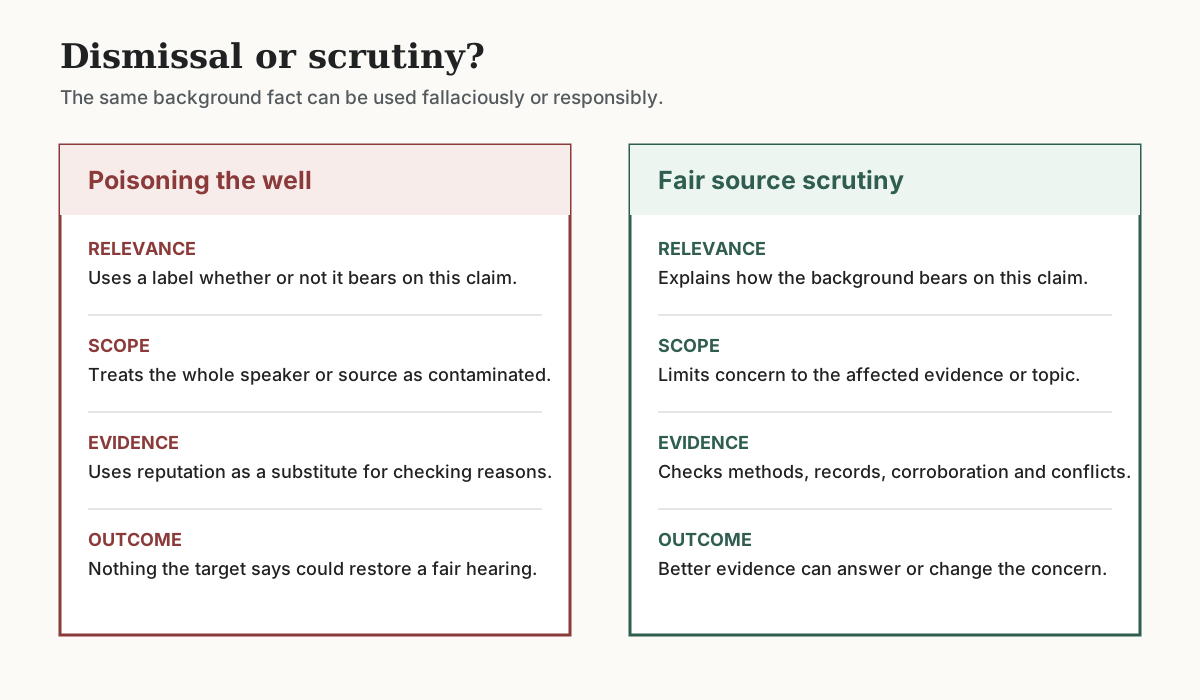
Poisoning the well turns a limited concern into a total ban: because the source has a flaw, affiliation, incentive, identity, or past error, nothing from that source deserves examination.
On this page
Why Sources Matter#
Many claims depend on testimony. A reader cannot personally repeat every experiment, attend every event, inspect every archive, or audit every account. Expertise, access, honesty, and method therefore matter to reasonable belief.
Informal-logic scholarship treats argument in real-life contexts and recognises that source credibility can be part of assessing ordinary arguments. The mistake is not considering a source; it is using an irrelevant or overbroad source judgement as a substitute for evaluation.[1]
The Six-Question Source Test#
- What exactly is the claim? Separate observation, interpretation, prediction, and recommendation.
- What is the source's route to knowing? Look for firsthand access, relevant training, records, or reproducible work.
- How was the information produced? Inspect sampling, measurement, editing, documentation, and review.
- What incentives or constraints matter? Identify a plausible path from the interest to distortion rather than merely naming an affiliation.
- What is the source's relevant track record? Compare similar claims, corrections, and methods—not unrelated personal conduct.
- What independent checks exist? Seek primary documents, data, replication, corroborating witnesses, or competing explanations.
Match the Check to the Claim#
| Claim type | Relevant source factors | Useful check |
|---|---|---|
| Firsthand observation | Presence, perception, contemporaneous record | Timestamps, images, independent witnesses |
| Expert interpretation | Training in the narrow field, method, uncertainty | Peer criticism, reproducibility, competing analyses |
| Historical claim | Primary-source access, provenance, context | Archive record, edition, locator, specialist scholarship |
| Statistical claim | Dataset, sampling, definition, calculation | Recalculate and compare independent datasets |
| Prediction | Model assumptions and comparable track record | Back-testing, calibration, alternative scenarios |
| Recommendation | Values, trade-offs, affected groups, evidence | Make criteria explicit and compare options |
Bias, Incentives, and Conflicts of Interest#
“Biased” is too vague to do analytical work. Ask whether the concern involves selection of evidence, measurement, framing, interpretation, publication, or undisclosed control over the result.
A conflict of interest raises the value of transparency and independent verification. It does not mechanically reverse truth values: a funded study is not false because it is funded, and an unfunded study is not sound because it is independent.
Use symmetry. Apply comparable scrutiny to sources that support and challenge your preferred view.
Identity, Experience, and Position to Know#
Personal experience can create important access to facts and social practices. It does not make a participant infallible, and lack of one broad identity trait does not by itself make another participant unable to reason or learn about an issue.[3][2]
Ask what experience provides in this case: direct observation, contextual understanding, interpretive vocabulary, or evidence of effects. Then assess the resulting claim with the right form of corroboration.
Warning Signs of Blanket Dismissal#
- The source label is broader than the claim: “mainstream,” “corporate,” “activist,” “elite,” or “outsider” does all the work.
- The criticism would apply to any possible contribution from the target.
- No evidence could rehabilitate the source and no check is proposed.
- Unrelated conduct is substituted for competence or access.
- The same relationship is condemned on one side and ignored on the other.
- Readers are discouraged from opening, quoting, or inspecting the underlying material.
Worked Example: An Industry-Funded Study#
| Step | Question |
|---|---|
| Disclosure | Who funded the study, and what control did the funder have over protocol, data, analysis, and publication? |
| Method | Were outcomes and analyses specified in advance? Is the sample appropriate? |
| Transparency | Are protocol, data, code, and deviations available where ethical and lawful? |
| Comparison | Do independent teams using different data reach similar conclusions? |
| Claim scope | Does the public summary go beyond what the results support? |
| Verdict | Assign confidence to the result; do not issue a moral verdict on everyone involved. |
Language for Responsible Criticism#
This source has a material interest in the outcome. That does not settle the claim, but it changes the checks we should require: full disclosure, access to the method, and independent corroboration.
Apply the Test to AI Authorship#
When a report is labelled AI-generated, separate how it was produced from whether its evidence supports the conclusion and whether an applicable rule was followed. A disclosure may answer the authorship question without settling either of the others.
In the AI-authorship case study, the same library proposal is assessed under three different evidence conditions. Use it to practise choosing a check that addresses the actual concern.
Frequently asked questions#
Is mentioning bias always poisoning the well?
No. Bias can affect what a source notices, measures, or reports. A fair criticism identifies the relevant mechanism and calls for an appropriate check; a poisoned-well move treats a broad allegation of bias as permission to ignore the claim.[1]
Can true information be used to poison the well?
Yes. A true detail can be irrelevant, exaggerated, or made to bear more weight than it can support. Truth is necessary for responsible source criticism, but truth alone does not establish relevance or justify blanket dismissal.[3]
Is a conflict-of-interest warning fallacious?
Not by itself. A disclosed financial or institutional interest can justify checking methods, documents, data, and independent corroboration. It becomes fallacious when the conflict is treated as proof that every associated claim is false.[1]
When may a source's track record matter?
A documented record of fabrication, repeated failed predictions, lack of access, or missing expertise can affect the weight given to testimony. The concern should be specific to the kind of claim and should not make contrary evidence invisible.[1]
Is fact-checking poisoning the well?
No. Fact-checking tests a stated claim against evidence. Announcing that a speaker is a liar so that nobody need check the next claim is a different move.[1]
Companion video channel
Further watching on Slopernet
Slopernet is Poisonwell.com's companion channel for longer discussions. It is not included in the evidence bibliography merely because the two projects are related.
References#
Leo Groarke. The Stanford Encyclopedia of Philosophy. Metaphysics Research Lab, Stanford University. 2026. Sections on informal argument evaluation and ad hominem.
Scholarly overview used for the broader context of evaluating ordinary-language arguments and for the point that source criticism can sometimes be relevant rather than automatically fallacious.
Douglas N. Walton. Argumentation. Argumentation, volume 20, issue 3, pages 273–307. 2006. pp. 273–307.
Peer-reviewed analysis of poisoning the well as a strategic personal attack that can prevent an opponent from contributing arguments to a critical discussion.
Hendrik Kotzee. Argumentation. Argumentation, volume 24, issue 3, pages 265–281. 2010. pp. 265–281.
Peer-reviewed discussion of when a participant's background can be relevant and why broad identity facts alone do not legitimately disqualify participation.
Bradley Dowden. Internet Encyclopedia of Philosophy. Internet Encyclopedia of Philosophy. Entries on Ad Hominem, Poisoning the Well, Straw Man, Red Herring, and related fallacies.
Peer-reviewed reference used for concise fallacy definitions and for the common classification of poisoning the well as preemptive circumstantial ad hominem.
Revision history
- : Added an AI-authorship application separating provenance, evidence, and policy, with a linked worked case. — reviewed by Poisonwell Editorial Team
- : New guide distinguishing evidence-based source evaluation from blanket dismissal. — reviewed by Poisonwell Editorial Team