
A good response does two things at once: it refuses automatic dismissal and preserves any source scrutiny that is genuinely relevant.
The aim is not to win a contest over fallacy labels. It is to recover the claim, connect credibility concerns to evidence, and give the audience a fair way to decide.
On this page
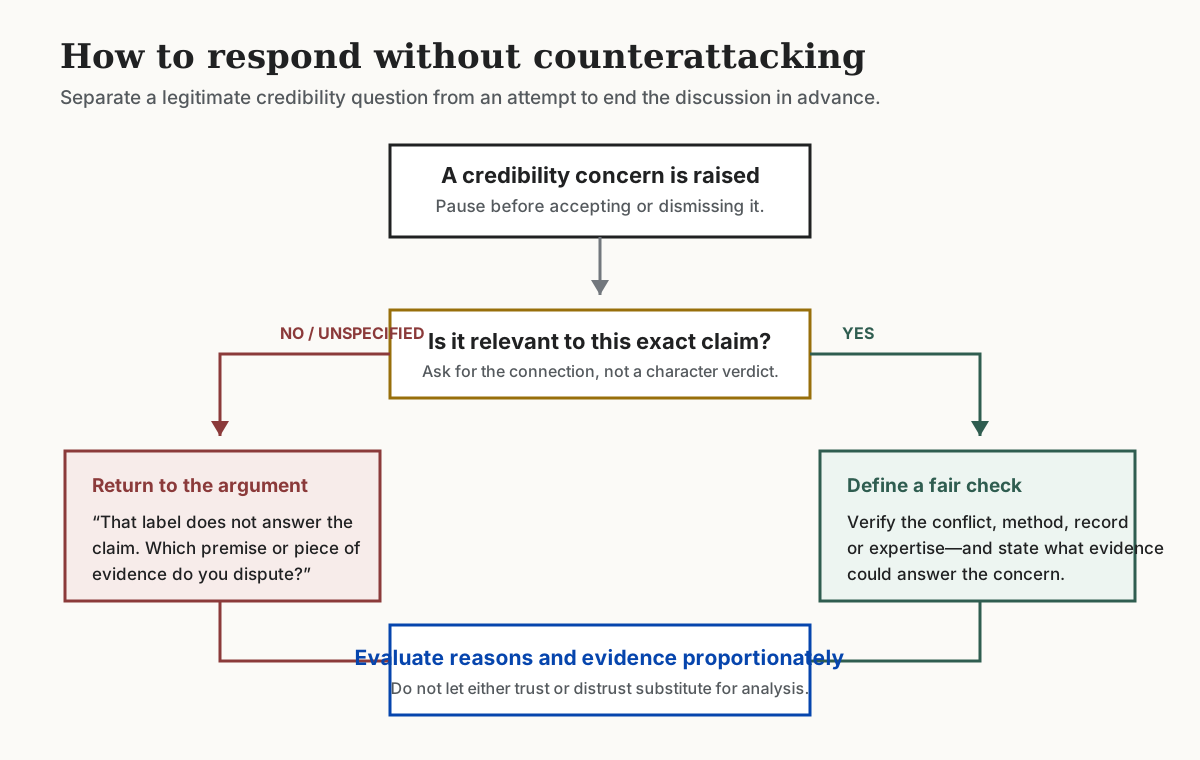
Response Decision Tree#
- Identify the allegation: character, motive, identity, affiliation, expertise, access, or track record.
- Ask whether it is accurate. Do not build a response around denying a true fact.
- Ask whether it is relevant to this kind of claim and how much weight it deserves.
- If relevant, propose disclosure, corroboration, replication, documentation, or another check.
- If irrelevant or sweeping, state that it does not answer the claim and return to the evidence.
A Six-Step Framework#
- Pause. Answer the move rather than the insult.
- Recover the proposition. Say exactly what has and has not been claimed.
- Concede relevant background. Acknowledgement makes the distinction credible.
- Limit the inference. Explain why the background does not justify blanket rejection.
- Offer a test. Name the document, criterion, observation, or independent source that matters.
- Return the floor. Invite a direct objection to the claim.
Scripts by Context#
| Setting | Response |
|---|---|
| Meeting | Past caution may be relevant. Can we assess this proposal against the agreed cost, risk, and user-impact criteria? |
| Public debate | That label describes the critic, not the objection. Which premise or consequence is wrong? |
| Research | Funding is a proper disclosure question. Which design choice could it have affected, and can the analysis be reproduced? |
| Classroom | Before we decide whether the author is reliable, what is the author's actual claim and evidence? |
| Online | A motive label does not answer the post. Quote the strongest claim and explain what fails. |
| Family | Our history matters, but let me state the present concern first; then we can decide whether the pattern changes it. |
When the Allegation Is True#
Do not answer a documented conflict of interest by pretending conflicts never matter. A stronger response is: “Yes, that relationship should be disclosed. The data and method are public, so here is how an independent person can check the result.”
Do not answer a real past error by asking everyone to forget it. Say what changed: a corrected method, new evidence, independent review, or a narrower claim.
Conceding the relevant fact prevents the discussion from becoming a referendum on your honesty and keeps the important distinction visible: lower initial confidence is not the same as automatic falsity.
When to Name the Fallacy#
Use the label if the audience knows it and the label shortens the explanation. In most live disagreements, description is clearer: “That comment tells us how to judge the speaker before we hear the evidence.”
A fallacy label can itself become a conversation-stopper. If somebody calls every credibility challenge “poisoning the well,” ask whether they are using the label to avoid legitimate scrutiny.
What Audiences and Moderators Can Do#
- Require the target claim to be stated before motives are debated.
- Ask the critic to connect a credibility fact to a specific evidential risk.
- Separate personal or performance feedback from the decision currently being made.
- Give the targeted participant enough time to present the relevant evidence.
- Summarise points of agreement and list the remaining checkable disputes.
Responses That Usually Make Things Worse#
| Avoid | Why | Try instead |
|---|---|---|
| A counter-smear | It confirms that personalities are the issue. | Return to the proposition and evidence. |
| A long defence of your character | The original claim disappears. | Concede or deny one relevant fact, then narrow its significance. |
| “Credentials never matter” | That is false for many forms of testimony. | Match expertise and access to the specific claim. |
| Merely shouting “fallacy” | A label supplies no repair. | Explain what was skipped and propose a test. |
| Assuming the target must be right | Bad reasoning can support a true or false conclusion. | Evaluate the claim independently. |
A Reusable Written Response#
The background point is worth separating from the substantive claim. If it affects reliability, please identify the mechanism and a check we can apply. Otherwise, the unresolved question remains: [state the claim]. The relevant evidence is [name it], and a fair test would be [method].
Frequently asked questions#
How can I recognize poisoning the well?
Look for timing, scope, and substitution: negative framing arrives before the contribution; it disqualifies broadly; and it takes the place of answering the reasons or evidence.
How should I respond?
Acknowledge any relevant background, ask exactly how it bears on the present claim, and return to a shared test: "That concern may justify checking the source. Which premise, document, or measurement does it undermine?"
Should I call it a fallacy during an argument?
Only if the label will clarify the problem. Often it is more productive to describe the move in ordinary language—"we are being asked to judge the speaker before hearing the evidence"—and then identify what should be evaluated.
What if the negative allegation is true?
Concede what is established, limit its significance, and propose a check. For example: "The funding relationship is real, so independent replication matters; it does not by itself show that this dataset is wrong."
How can I avoid poisoning the well myself?
State the other side's claim accurately, make any credibility concern specific and proportionate, explain why it matters, and say what evidence could overcome the concern.
Companion video channel
Further watching on Slopernet
Slopernet complements this written framework with longer-form discussion of rhetorical tactics and language.
References#
Douglas N. Walton. Argumentation. Argumentation, volume 20, issue 3, pages 273–307. 2006. pp. 273–307.
Peer-reviewed analysis of poisoning the well as a strategic personal attack that can prevent an opponent from contributing arguments to a critical discussion.
Hendrik Kotzee. Argumentation. Argumentation, volume 24, issue 3, pages 265–281. 2010. pp. 265–281.
Peer-reviewed discussion of when a participant's background can be relevant and why broad identity facts alone do not legitimately disqualify participation.
Leo Groarke. The Stanford Encyclopedia of Philosophy. Metaphysics Research Lab, Stanford University. 2026. Sections on informal argument evaluation and ad hominem.
Scholarly overview used for the broader context of evaluating ordinary-language arguments and for the point that source criticism can sometimes be relevant rather than automatically fallacious.
Bradley Dowden. Internet Encyclopedia of Philosophy. Internet Encyclopedia of Philosophy. Entries on Ad Hominem, Poisoning the Well, Straw Man, Red Herring, and related fallacies.
Peer-reviewed reference used for concise fallacy definitions and for the common classification of poisoning the well as preemptive circumstantial ad hominem.
Revision history
- : Expanded into a decision-based response guide with source-criticism safeguards and context-specific scripts. — reviewed by Poisonwell Editorial Team