
A useful example must show more than a personal criticism. Look for negative framing, a broad invitation to distrust, and a claim that has not yet received a fair test.
All people, organisations, meetings, studies, and quotations on this page are fictional. The examples are designed to isolate the reasoning pattern.
On this page
Choose a Scenario#
1. Workplace: The Risk Review#
Claim: The release contains a defect that may justify a delay.
Discrediting move: The team benefits from delay, so its report is framed as self-interest.
Missing evidence check: Can another person reproduce the defect, and how severe is it?
The team's incentive may be relevant, but the wording arrives before the risk report and encourages the room to hear any evidence as self-interest.
Fair rewrite: “Imran's team may benefit from delay. Show the defect, affected users, reproduction steps, severity, and estimated repair time so the decision can use shared criteria.”
Before Imran presents the release risk, remember that his team gets more time whenever a launch is delayed.
Extended workplace analysis
Follow a realistic accessibility-risk scenario through evidence, meeting procedure, and manager response.
Read the workplace case study
2. Public Policy: The Transport Hearing#
Claim: The transport proposal may cost more or serve fewer people than an alternative.
Discrediting move: Critics are portrayed as opponents of progress before their objections are heard.
Missing evidence check: What do the cost, coverage, maintenance, and accessibility comparisons show?
The label makes disagreement with one proposal sound like hostility to progress itself. It answers neither cost, coverage, maintenance, accessibility, nor alternatives.
Fair rewrite: “Critics of this proposal should compare its expected benefits and costs with the maintenance-first alternative.”
You will hear objections from people who have always opposed progress.
Extended political analysis
Examine identity cues, moral framing, audience pressure, and evidence-based moderation in a neutral fictional case.
Read the public-policy case study
3. Research: Funding and Incentives#
Claim: The study reports a result that may support its stated conclusion.
Discrediting move: A general story about grants is substituted for assessment of this study.
Missing evidence check: Do the protocol, data, analysis, and independent findings support that conclusion?
General incentive claims can motivate scrutiny, but they do not identify an error in this protocol, dataset, analysis, or inference.
Fair rewrite: “Disclose funding and preregistration, make the data available where appropriate, and compare the result with independent studies.”
This study came from a university lab, and academics need dramatic findings to win grants, so treat the presentation as career theatre.
Extended research analysis
Use a method-first checklist for funding, expertise, data access, replication, and uncertainty.
Read the research-panel case study
4. Social Media: The Quote-Post#
Claim: A planning method may be unsuitable for interruption-heavy work.
Discrediting move: The writer is labelled an excuse-maker before readers open the argument.
Missing evidence check: Do the proposed alternatives address the work conditions described?
Readers see the motive label before they open the original thread. The label supplies a low-effort interpretation of every later example.
Fair rewrite: “The thread underestimates how adaptable this method can be; its claim about interruption-heavy work does not account for these two alternatives.”
Here come the excuse-makers. People who dislike discipline always write essays about why this method cannot work.
Extended social-media analysis
See how quote-post order, labels, pile-ons, and context collapse affect the audience.
Read the social-media case study
5. Family: Old Roles in a New Decision#
Claim: A current travel constraint may require changing the plan.
Discrediting move: Sam is assigned a fixed role that discredits any new concern.
Missing evidence check: What is the present constraint, and which options accommodate it?
A family history may be real, but it can assign Sam a fixed role that absorbs any present reason. The current travel constraint still needs to be heard.
Fair rewrite: “Let's hear the current constraint. Afterwards we can decide whether the broader pattern affects this decision.”
Before Sam suggests anything, remember that Sam always makes plans smaller and calls it concern.
Extended family analysis
Separate a current practical claim from accumulated history without pretending that history never matters.
Read the family-discussion case study
Paired Examples: Fallacy or Fair Scrutiny?#
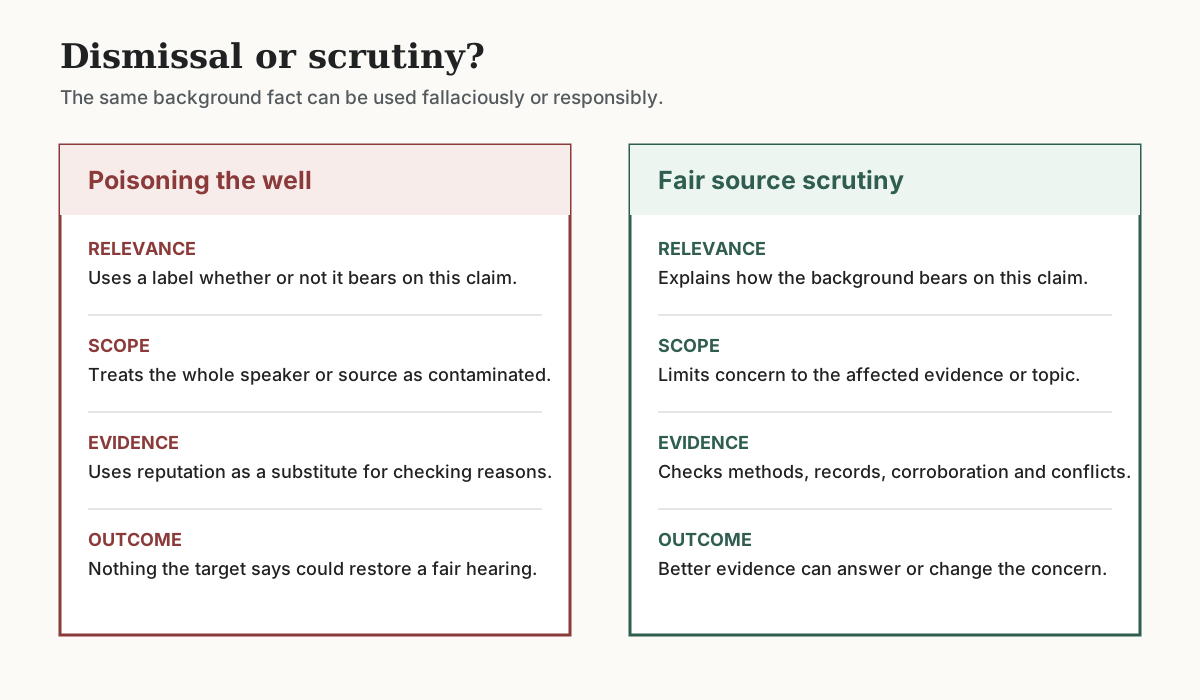
The right column retains any relevant credibility concern and connects it to a checkable question.
| Setting | Poisoned-well wording | Fairer wording |
|---|---|---|
| Workplace | Before Alex reports the problem, remember that Alex always expects the worst. | Alex has raised several risks; ask for reproduction steps, user impact, and the cost of each remedy. |
| Public policy | Anyone questioning this proposal is against safer streets. | Critics should explain which safety outcome they dispute and compare the available evidence. |
| Research | The authors received industry funding, so the study is worthless. | The funding is relevant; inspect the protocol, disclosure, data, and independent replication. |
| Family | Before Sam explains, remember that Sam always makes everything dramatic. | Hear the present concern first, then decide whether the earlier pattern is relevant. |
Clear Non-Examples#
| Statement | Why it is not poisoning the well |
|---|---|
| The report says 41%, but the linked dataset yields 14%. | It identifies a checkable conflict with the claim. |
| The witness was not present, according to the timestamp and access log. | Firsthand access is directly relevant to this testimony. |
| The trial was funded by the manufacturer; compare its protocol and result with independent trials. | The conflict leads to a defined verification step. |
| Your proposal assumes ten staff-hours, but the task log shows thirty. | It challenges an assumption rather than pre-discrediting the proposer. |
Borderline Cases#
“This outlet has repeatedly corrected false stories” is incomplete. It may be a responsible warning or a smear. Ask which stories, how similar they are to the present report, whether corrections were timely, and whether independent evidence confirms this claim.
“She has no training in this field” may matter for expert testimony, but not necessarily for a reproducible calculation or firsthand observation. Expertise must be matched to the exact task.
“He benefits if the proposal passes” identifies an incentive, not a refutation. It becomes useful when it leads to disclosure, comparison, audit, or independent evidence.
Five Questions for Any Example#
- What exact contribution has not yet been answered?
- What negative information is supplied about its source?
- Is that information accurate and relevant to this kind of claim?
- Does the speaker propose a test, or merely demand distrust?
- Would the contribution still be examined if the negative information were true?
Frequently asked questions#
What is the shortest example?
"Before you hear Mara's proposal, remember that she always has an agenda." The remark gives the audience a reason to distrust Mara before the proposal is heard.
Is mentioning bias always poisoning the well?
No. Bias can affect what a source notices, measures, or reports. A fair criticism identifies the relevant mechanism and calls for an appropriate check; a poisoned-well move treats a broad allegation of bias as permission to ignore the claim.[4]
Can true information be used to poison the well?
Yes. A true detail can be irrelevant, exaggerated, or made to bear more weight than it can support. Truth is necessary for responsible source criticism, but truth alone does not establish relevance or justify blanket dismissal.[3]
Is a conflict-of-interest warning fallacious?
Not by itself. A disclosed financial or institutional interest can justify checking methods, documents, data, and independent corroboration. It becomes fallacious when the conflict is treated as proof that every associated claim is false.[4]
When may a source's track record matter?
A documented record of fabrication, repeated failed predictions, lack of access, or missing expertise can affect the weight given to testimony. The concern should be specific to the kind of claim and should not make contrary evidence invisible.[4]
Is fact-checking poisoning the well?
No. Fact-checking tests a stated claim against evidence. Announcing that a speaker is a liar so that nobody need check the next claim is a different move.[4]
How can I recognize poisoning the well?
Look for timing, scope, and substitution: negative framing arrives before the contribution; it disqualifies broadly; and it takes the place of answering the reasons or evidence.
What if the negative allegation is true?
Concede what is established, limit its significance, and propose a check. For example: "The funding relationship is real, so independent replication matters; it does not by itself show that this dataset is wrong."
Companion video channel
Further watching on Slopernet
Slopernet is the companion channel for long-form spoken examples of rhetoric and phrase history. The cases on this page remain self-contained and readable without video.
References#
Bradley Dowden. Internet Encyclopedia of Philosophy. Internet Encyclopedia of Philosophy. Entries on Ad Hominem, Poisoning the Well, Straw Man, Red Herring, and related fallacies.
Peer-reviewed reference used for concise fallacy definitions and for the common classification of poisoning the well as preemptive circumstantial ad hominem.
Douglas N. Walton. Argumentation. Argumentation, volume 20, issue 3, pages 273–307. 2006. pp. 273–307.
Peer-reviewed analysis of poisoning the well as a strategic personal attack that can prevent an opponent from contributing arguments to a critical discussion.
Hendrik Kotzee. Argumentation. Argumentation, volume 24, issue 3, pages 265–281. 2010. pp. 265–281.
Peer-reviewed discussion of when a participant's background can be relevant and why broad identity facts alone do not legitimately disqualify participation.
Leo Groarke. The Stanford Encyclopedia of Philosophy. Metaphysics Research Lab, Stanford University. 2026. Sections on informal argument evaluation and ad hominem.
Scholarly overview used for the broader context of evaluating ordinary-language arguments and for the point that source criticism can sometimes be relevant rather than automatically fallacious.
Revision history
- : Added a scenario index, explicit evidence checks, and a linked AI-authorship case alongside the five worked scenarios. — reviewed by Poisonwell Editorial Team
- : Put the direct meaning before the examples and retained the recognition rule as the practical test. — reviewed by Poisonwell Editorial Team
- : Replaced the example list with annotated, paired, non-example, and borderline-case analysis. — reviewed by Poisonwell Editorial Team