
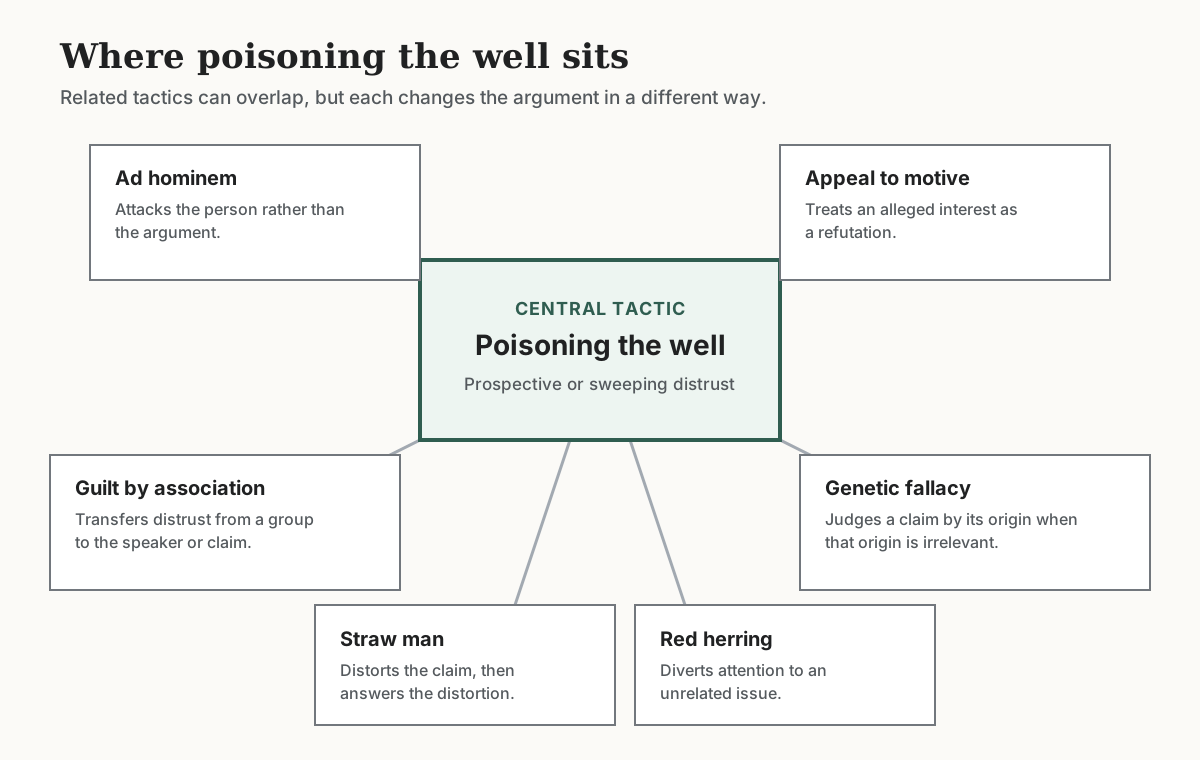
Fallacy names are most useful when they identify a repair. The comparisons below ask what has been displaced: a speaker, an argument, a source, a topic, a reply, or an unstated assumption.
Poisoning the well is commonly grouped with circumstantial ad hominem, but specialist analysis also treats it as an attempt to exclude a participant's contribution from a critical discussion.[1][2]
On this page
Comparison Map#
Eight Comparisons#
Ad hominem
A broad family of irrelevant personal attacks; poisoning the well is usually preemptive and audience-shaping.
Compare ad hominemAppeal to motive
Infers that a claim should be rejected from why the speaker supposedly advances it.
Compare appeal to motiveGuilt by association
Transfers discredit from an associated person or group to the present target.
Compare guilt by associationGenetic fallacy
Evaluates a belief or claim solely by where it came from rather than its present support.
Compare genetic fallacyStraw man
Substitutes a weaker or distorted version of an argument and attacks that version.
Compare straw manRed herring
Pulls attention towards a side issue rather than answering the point under discussion.
Compare red herringTu quoque
Replies to criticism by alleging that the critic is hypocritical or equally at fault.
Compare tu quoqueLoaded question
Builds a disputed assumption into a question so that any direct answer appears to concede it.
Compare loaded question
One Sentence Can Contain Several Fallacies#
The opening poisons the well, the activist association invites guilt by association, “opposes every useful technology” may be a straw man, and the final question presupposes an intention to frighten.
Listing labels is less important than repairing the discussion: ask for Nia's actual safety claim, its evidence, the relevance of the association, and the unsupported assumption in the question.
Before Nia gives her so-called safety argument, remember that her activist friends oppose every useful technology—why is she trying to frighten us again?
Do Not Commit the Fallacy Fallacy#
A defective argument does not make its conclusion false. If a speaker poisons the well against a report, the report may still be poor; if a critic uses a straw man, the original proposal may still be mistaken.
The repair is always to restore the missing evaluation, not to award truth to whichever side avoided the named fallacy.
Frequently asked questions#
Is poisoning the well a type of ad hominem?
It is often classified as a preemptive circumstantial ad hominem, because attention moves from an argument to a supposedly disqualifying fact about its source. Douglas Walton also analyzes it as a discussion-silencing tactic that can block a participant's ability to argue.[1][2]
How is it different from a straw man?
A straw man misstates a position and attacks the weaker substitute. Poisoning the well discredits the person or source before fair consideration. A sentence can do both, but the defects are different.
How is it different from guilt by association?
Guilt by association treats a relationship with a disliked person or group as evidence against someone. It becomes a poisoned-well tactic when that association is used to pre-disqualify whatever the person is about to argue.
How is it different from a red herring?
A red herring introduces a distracting issue. Poisoning the well specifically damages a participant's or source's standing. A personal smear can be both when it also draws the discussion away from the claim.
How is it different from tu quoque?
Tu quoque answers criticism by alleging that the critic is hypocritical: "you do it too." Poisoning the well prepares an audience to distrust a participant before their contribution receives a hearing.
How is it different from the genetic fallacy?
The genetic fallacy evaluates a claim solely by its origin rather than its merits. Poisoning the well is the preemptive social maneuver of making a source seem unhearable. The same remark can instantiate both patterns.
Companion video channel
Further watching on Slopernet
Slopernet is the site's companion channel for longer discussions of rhetoric and related phrases; each written comparison remains independently sourced.
References#
Bradley Dowden. Internet Encyclopedia of Philosophy. Internet Encyclopedia of Philosophy. Entries on Ad Hominem, Poisoning the Well, Straw Man, Red Herring, and related fallacies.
Peer-reviewed reference used for concise fallacy definitions and for the common classification of poisoning the well as preemptive circumstantial ad hominem.
Douglas N. Walton. Argumentation. Argumentation, volume 20, issue 3, pages 273–307. 2006. pp. 273–307.
Peer-reviewed analysis of poisoning the well as a strategic personal attack that can prevent an opponent from contributing arguments to a critical discussion.
Leo Groarke. The Stanford Encyclopedia of Philosophy. Metaphysics Research Lab, Stanford University. 2026. Sections on informal argument evaluation and ad hominem.
Scholarly overview used for the broader context of evaluating ordinary-language arguments and for the point that source criticism can sometimes be relevant rather than automatically fallacious.
Revision history
- : Expanded the hub to eight distinct comparisons, including genetic fallacy and composite cases. — reviewed by Poisonwell Editorial Team